
KEWI Champions National NRW Dialogue Through Skills, Innovation and Strategic Partnerships at 2026 NRW Conference
As Kenya continues to lose nearly half of its treated water before it reaches consumers, the conversation around Non-Revenue Water (NRW) is increasingly shifting from infrastructure alone to the people responsible for managing it. At the Non-Revenue Water Management Conference 2026 in Naivasha, the Kenya Water Institute (KEWI) emerged as a leading voice, demonstrating that sustainable NRW reduction begins with building a technically competent workforce supported by strong partnerships and practical innovation.
Held at Lake Naivasha Resort under the theme "Improving Non-Revenue Water (NRW) Management by Leveraging Technology and Innovation," the conference attracted more than 500 delegates, over 50 Kenyan and international speakers and panellists, and featured five plenary sessions, nine breakout sessions and three parallel technical tracks. More than 80 research abstracts were also presented, reflecting growing interest in innovative approaches to addressing one of the water sector's most persistent challenges.
KEWI's contribution stood out by shifting the focus from technology itself to the people who use it.
Delivering a presentation on KEWI's role in reducing Non-Revenue Water through people, partnerships and innovation, Engineer Simon Ndeweni, Coordinator of the KEWI Non-Revenue Water Centre of Excellence, observed that Kenya's 48 percent NRW highlights the need to strengthen technical capacity alongside investments in infrastructure.
He explained that the National NRW Centre of Excellence, established at KEWI in partnership with Gatsby Africa, was founded on a simple but transformative mission: building the people who reduce water losses.
According to Engineer Ndeweni, practical, hands-on training using real utility applications enables water professionals to convert technology into measurable operational results. He showcased industry-standard technologies incorporated into KEWI's training programmes, including ground microphones, correlators and noise loggers for leak detection, ultrasonic flow meters and pressure loggers for flow monitoring, smart metering and meter testing, GIS-based network mapping and District Metered Area demonstrations.
"Practical learning transforms technology into operational competence," he said, emphasizing that technical equipment only delivers results when operated by skilled professionals.
He noted that KEWI has steadily strengthened its capacity-building programmes by developing a workforce equipped with practical competencies that improve confidence and performance in water utilities. Through the Centre of Excellence, utilities have enhanced operational efficiency, strengthened decision-making, sustained NRW reduction programmes and improved service delivery to consumers.
Engineer Ndeweni further attributed the Institute's growing impact to strategic partnerships that have accelerated collaboration, technology transfer and knowledge exchange across the sector. He identified five principles underpinning KEWI's approach: strengthening workforce competence, embedding practical skills, sustaining continuous capacity building, promoting innovative partnerships and fostering continuous improvement to build resilient utilities.
The discussion on capacity building continued during the plenary session on Research and Capacity Strengthening for NRW Management, where Senior Deputy Director for Research, Strategy and Business Development, Dr. Evans Ayao, represented Director and Chief Executive Officer Dr. Leiro Letangule.
Dr. Ayao argued that meaningful reductions in Non-Revenue Water require a fundamental shift in how water sector professionals are trained and developed. He stressed that technology and infrastructure alone cannot solve NRW unless supported by continuous investment in people, research and institutional capacity.
He highlighted KEWI's practical interventions, including On-the-Job Training programmes implemented with the Japan International Cooperation Agency (JICA) and water utilities, the establishment of the KEWI Non-Revenue Water Centre of Excellence, international collaborations with Operators Without Borders and IHE Delft, specialized short courses that strengthen technical and managerial competencies, and collaborative policy development with Gatsby Africa aimed at supporting nationwide NRW capacity building.
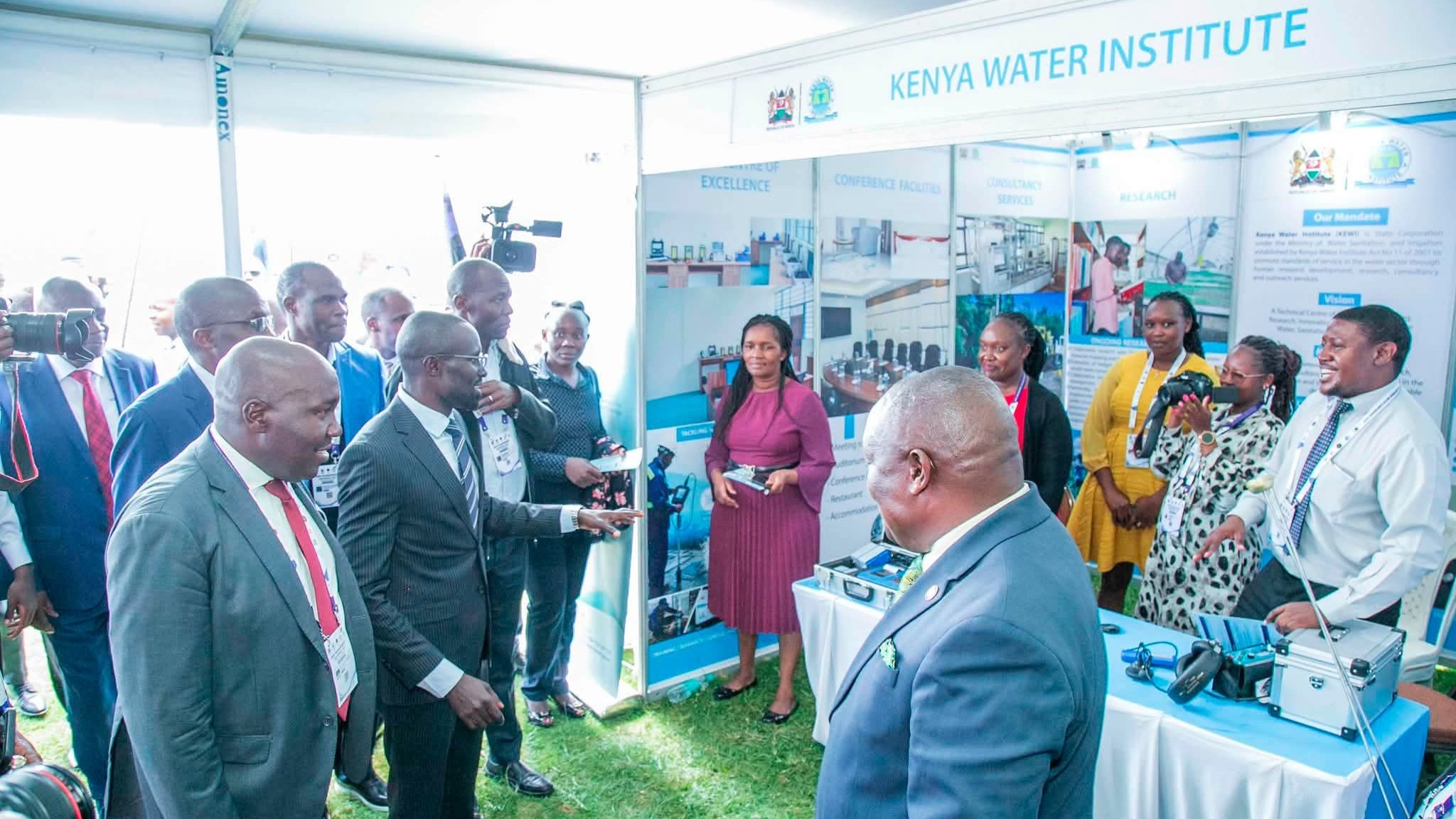
Beyond the technical sessions, KEWI reinforced its presence through an exhibition showcasing its diverse training programmes, research initiatives and professional services. Led by Governing Council Chairperson Hon. Patrick Musili Mbangula and Director/Chief Executive Officer Dr. Leiro Letangule, EBS, the Institute demonstrated that addressing Kenya's water losses requires more than advanced technology. It requires competent professionals capable of applying innovation in the field, strengthening utility performance and delivering reliable water services to communities across the country.